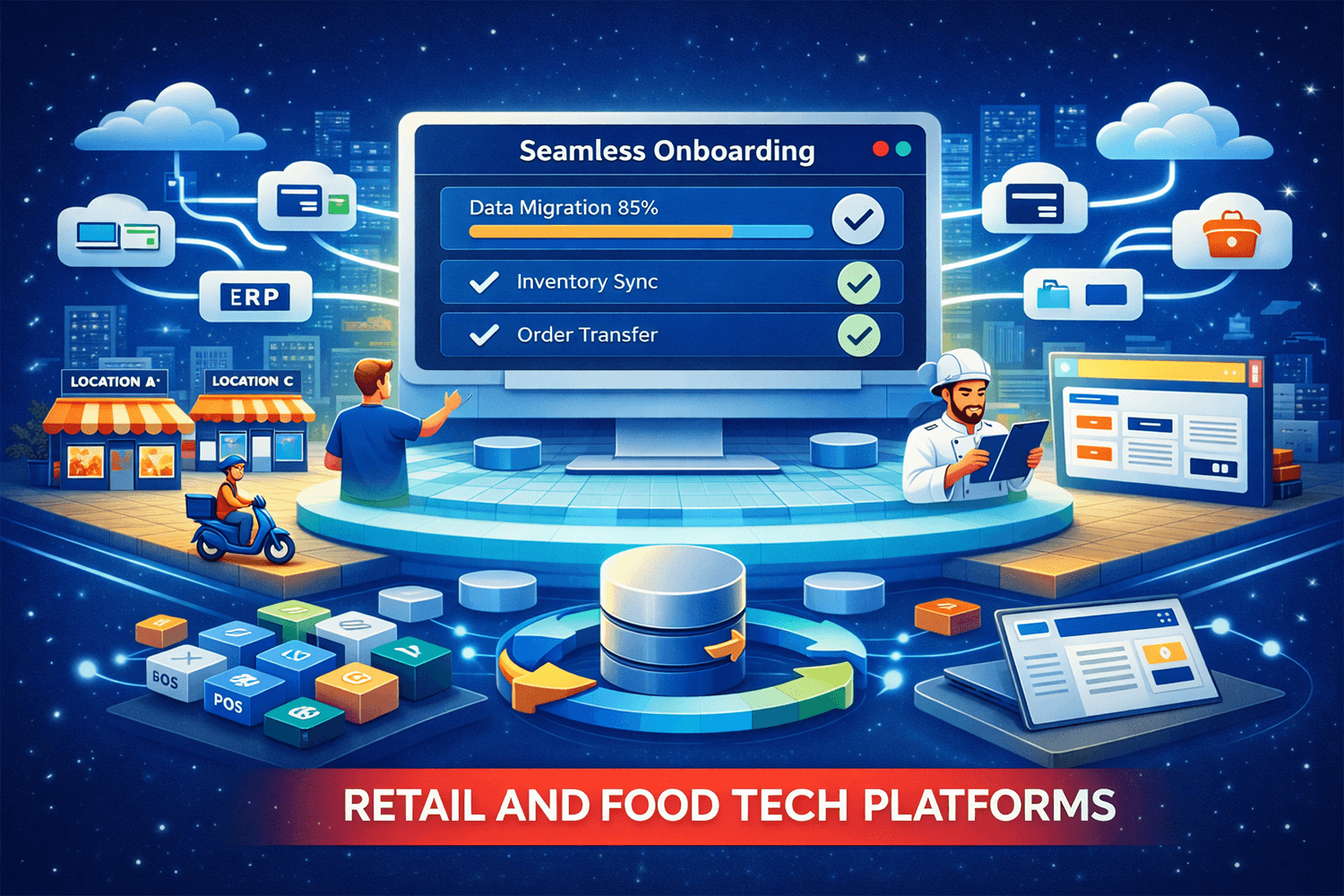
Sales and solutions teams at retail and food‑tech platforms often see promising deals slow down when conversations shift to integrations, data migration, and onboarding. Prospects worry about risk, timelines, and internal effort, which can stall even the strongest commercial fit.
Why integrations slow deals
Most buyers operate complex stacks across POS, ERP, accounting, marketplaces, delivery partners, and marketing tools. When a new platform is introduced, they immediately ask: “How will this work with everything we already use?” Long integration projects, manual migrations, and inconsistent data flows make it hard for champions to push deals through.
A better approach is to treat integrations and migrations as a product, not a project, something standardized, repeatable, and clearly communicated in every sales cycle. Framing integration as a defined motion also makes it easier to align with the kind of automated onboarding and migration journeys described on LINK’s migration page.
What a modern integration layer looks like
A robust integration and migration layer typically includes:
- Pre-built connectors for common systems in retail and food-tech, with the flexibility to customize fields, mappings, and logic as merchant needs evolve. This mirrors how many modern integration portfolios expose connectors across POS, ERP, accounting, and marketplaces, similar to what is highlighted in LINK’s integrations section.
- Automated historical data migration and ongoing sync, so merchants are not starting from scratch. A well-designed migration engine can move data for locations, orders, inventory, catalogs, and customers before go-live, and then keep everything up to date in the background.
- Embeddable, white-label flows that live inside your own product, giving a native onboarding experience and reducing security concerns. This lets merchants trigger migrations and integrations directly from your dashboard.
With this kind of foundation, sales and solutions teams can promise realistic timelines, support multi‑location rollouts, and scale merchant onboarding without overloading engineering. It also becomes much easier to standardize playbooks and SLAs across regions and verticals.
Making this a competitive advantage
When integration is positioned as a known, low‑risk motion – with clear pricing, implementation playbooks, and case‑study proof – it becomes a reason to choose your platform, not a reason to delay. Sharing real‑world stories of complex POS or ERP integrations, multi‑outlet retail rollouts, or restaurant migrations helps buyers see that their edge cases have already been solved. Packaging integrations and migrations with transparent, usage‑based or volume‑based pricing can make approvals smoother. Instead of bespoke one‑off quotes each time, sales teams can reference standard tiers and options.
If you want to turn integration and onboarding into a consistent competitive advantage for your retail or food‑tech platform, explore how a dedicated integration and migration layer can support your GTM and product teams. To see how this works in practice and what it could look like for your stack, review LinkToAny’s case studies, explore how automated migrations are handled, learn more about the integrations portfolio.
You can request a demo from LinkToAny at https://linktoany.com/demo-request-linktoany/ or message our team at sales@linktoany.com